SEND SORTED GUIDE • SCHOOL ANXIETY
School Anxiety in Children: What to Do When Your Child Is Struggling to Attend School
If getting your child to school has become a daily struggle, you are not alone, and you are not failing. Watching a child in real distress is exhausting.
This guide takes things one step at a time: what may be going on, what to do on a hard morning, how to talk to school and where to turn if things do not improve. Take what is useful and leave the rest for another day.
Free EBSA & Attendance Tracker (PDF)What is school anxiety, and what does EBSA mean?
School anxiety describes worry or distress connected with school. It can affect how a child feels before, during or after the school day, and sometimes makes entering or staying in school very difficult. A child may want to learn and see friends but feel unable to cope with part of the experience.
EBSA means Emotionally Based School Avoidance. It is a description of attendance difficulties associated with emotional distress, not a formal medical diagnosis. Some professionals use other terms, including emotionally based school non-attendance. The label matters less than understanding the child’s needs and what is preventing them from accessing education.
Not every difficult morning means EBSA. Equally, good grades, a quiet classroom manner or occasional successful attendance do not tell you everything about a child’s wellbeing. Ask what school is like for your child rather than assuming they are simply choosing not to go.
This guide reflects the framework in England. Education law and services differ in Scotland, Wales and Northern Ireland. It provides general information, not a diagnosis or individual legal advice.
Signs of school anxiety to notice
Look for patterns, changes and the effect on everyday life, rather than using a checklist to diagnose your child. Possible signs include:
- Physical symptoms: tummy aches, headaches, nausea or feeling unwell, particularly before school or particular lessons. Physical symptoms are real and should not automatically be put down to anxiety.
- Morning distress: crying, panic, repeated reassurance-seeking, difficulty getting dressed, hiding or becoming unable to leave the house or enter school.
- Sunday-night worries: talking repeatedly about the next day, disrupted sleep or struggling to settle as the school week approaches.
- After-school meltdowns or exhaustion: seeming to cope at school but becoming overwhelmed, irritable or withdrawn at home. Holding things together all day can take considerable effort.
- Changes in daily life: eating or sleep difficulties, reduced confidence, loss of interest in activities, friendship worries or distress around homework.
These signs can have several explanations. If symptoms are persistent, severe, worsening or affecting ordinary activities, speak to your GP or another appropriate health professional. Seek medical advice about concerning physical symptoms rather than assuming they are school-related.
Our 10 Signs Your Child May Be Struggling With School article explores these clues in more detail. The NHS guidance on anxiety in children explains when worry may need further support.
Why might school feel overwhelming?
There may be more than one contributing factor. Try to understand the difficulty before deciding what the solution should be.
- Unmet SEND needs: learning, attention, communication or emotional regulation difficulties may make ordinary classroom demands much harder than they appear.
- Sensory differences: noisy corridors, crowded lunch halls, lighting, smells, uniform or unpredictable touch can be difficult for some children.
- Bullying or feeling unsafe: worries may involve another child, online behaviour or particular places and times. Ask school to investigate concerns rather than treating them only as an attendance issue.
- Friendship difficulties: loneliness, exclusion or uncertainty about social situations can make breaktimes and group work particularly stressful.
- Academic pressure: work that is difficult to access, fear of mistakes, tests, homework or feeling unable to keep up can contribute to distress.
- Change, health or separation worries: a new teacher, transitions, bereavement, physical illness or mental health difficulties may also affect attendance.
At a calm time, try asking: “Which part of the day feels hardest?” or “If we could change one thing at school, what would help?” Drawing, writing or choosing from a few options may be easier than explaining everything aloud. Give your child time; “I don’t know” does not mean there is no difficulty.
Record what happens before and after school, any particular days or situations, your child’s own words and what helps. Include times that go better, too. A simple record can help you and school spot barriers without requiring your child to repeatedly describe distressing experiences.
The free EBSA & Attendance Tracker below gives you a place to start. You do not need a diagnosis to begin recording concerns or asking for support.
What to do when your child is too distressed to attend school
A difficult morning can leave everyone overwhelmed. Focus on safety, a clear account of what is happening and coordinated support, rather than trying to settle every question at the school gate.
- Help your child become calmer. Use a quiet voice, reduce immediate demands and listen without dismissing the worry. Avoid threats, shaming or physical force to make a distressed child enter school. This is not a substitute for an agreed attendance plan.
- Contact school promptly. Follow its absence-reporting procedure, explain the symptoms and what your child is currently able to manage, and ask who can help that day. A message might say: “They are crying and feeling sick and cannot currently enter school. Can we speak with the pastoral lead about a supported arrival?”
- Ask about a realistic immediate adjustment. A trusted adult at a quieter entrance or a safe place to settle may help, if appropriate for your child. Agree arrangements with school; do not assume a late arrival or shortened day has been authorised.
- Keep a factual record. Note the time, symptoms, your child’s words, attendance, people contacted and the response. Keep emails and relevant professional advice together.
- Seek health advice when needed. Contact your GP or school nurse if anxiety is persistent, severe or interfering with everyday life, or physical symptoms are concerning. Ask about appropriate assessment, treatment or referral, including children and young people’s mental health services where relevant.
Attendance responsibilities still matter
Where a child of compulsory school age is registered at school, parents have a duty to ensure regular attendance, subject to the lawful exceptions, including being too ill to attend. EBSA is not an automatic exemption from attendance requirements and does not mean a parent can simply decide all absences are authorised.
DfE guidance says schools should authorise illness absence where a pupil cannot attend because of physical or mental ill health. Schools should not routinely require medical evidence for every illness absence, although evidence can be appropriate in some circumstances. Explain the situation, ask how it will be recorded and discuss any evidence needed. A GP appointment alone does not automatically establish that a child is unfit to attend school.
Stay in contact and engage with support. If a proposal is not workable, explain why and suggest a review rather than disappearing from communication. If you receive a penalty notice, prosecution warning or other formal attendance correspondence, seek individual advice promptly and do not ignore deadlines. General information here cannot determine the outcome of an individual case.
Sources: DfE statutory attendance guidance and mental health and attendance guidance.
How to talk to school — with an example email
Ask for a meeting with the teacher, pastoral lead and SENCO (Special Educational Needs Coordinator), as appropriate. Share what you are seeing at home even if your child appears settled in class. Ask school to consider lessons, transitions, toilets, lunch and breaktimes, not just classroom behaviour.
Bring a short record and prioritise two or three concerns. Ask who will coordinate support, what will happen immediately and when the plan will be reviewed. Before you leave, try to agree who will do what, by when, and how you will know whether it is helping.
A ready-to-copy email requesting a meeting
Copy the example below and replace the bracketed details. You do not need to use legal language or prove a diagnosis before asking for a conversation.
Subject: Request for meeting and support for [child’s name] — school anxiety and attendance

Dear [teacher / pastoral lead / SENCO],

I am concerned that [child’s name], in [class/year], is experiencing significant distress around school. We have noticed [brief examples, dates and your child’s own words]. This is affecting [attendance, sleep, physical symptoms or wellbeing].

We want to work with you to help [child’s name] access education safely and consistently. Please could we arrange a meeting with the relevant teacher, pastoral lead and SENCO to explore what is making school difficult?

I would like us to discuss:
• What school has noticed, including lessons, transitions and unstructured times.
• Any possible unmet learning, communication, sensory or emotional needs.
• Any bullying or friendship concerns and how these will be investigated.
• Immediate support, adjustments and whether SEN Support or advice from other professionals is needed.
• How any absence will be recorded, what information you need and how education will be supported if attendance is affected.
• A written plan naming who will do what, with an agreed review date.

I can share our attendance tracker and relevant information from professionals, where available. Please let me know who will coordinate support and some possible meeting dates.

Thank you,
[your name]
[contact details]
After a meeting, send a short email summarising the agreed actions and review date. If nothing happens, follow up with the named lead or SENCO and use the school’s complaints procedure if necessary. For immediate safety or bullying concerns, contact the relevant school safeguarding lead promptly.
Our EHCP evidence guide explains how to organise information without turning every conversation into a large paperwork exercise. You can also find the optional Communication Log in our printable tools; buying anything is not necessary to request support.
What might school-based support look like?
Support should address the reasons school feels difficult, not only set an attendance target. You can request support without waiting for a formal diagnosis. SEN Support is based on educational needs; a child does not have to be failing academically for school to explore social, emotional, communication or sensory difficulties.
Pastoral support and practical adjustments
- A named, trusted adult and a predictable check-in, with a backup if that person is away.
- A quieter arrival, clear information about changes and support during transitions.
- A safe space or agreed sensory breaks, with a plan for returning to learning.
- Supported breaktimes, a buddy where appropriate and specific action on bullying concerns.
- Clear, manageable instructions, adapted tasks and a review of homework demands.
- Access to the school nurse, pastoral team or other appropriate professional advice.
These are examples to discuss, not a standard package that suits every child. Ask your child what would feel helpful and check whether an adjustment works in practice. A quiet room that is unavailable when needed will not solve the problem.
SEN Support and reasonable adjustments
Ask the SENCO whether school should assess possible SEN and use an assess–plan–do–review approach: understand the need, agree provision, put it into practice and review its effect. A written plan should name the support and who provides it, rather than only asking your child to “be more resilient”.
For children who meet the Equality Act disability definition, schools have legal duties to make reasonable adjustments. Not every child experiencing anxiety necessarily meets that definition. School can still offer pastoral and needs-led support; do not wait for a diagnostic label before raising concerns.
Be careful with reduced timetables
A temporary part-time timetable may be used in very exceptional circumstances to meet an individual pupil’s needs. It should be agreed with parents, time-limited, regularly reviewed and have a clear plan towards full-time education. It must not be used simply to manage behaviour or become an indefinite replacement for appropriate support.
If this is proposed, ask what education and support your child will receive, how safety will be managed during non-attendance, how absence will be recorded and when the arrangement will end or change. Seek advice if a reduced timetable continues without a suitable plan.
Sources: GOV.UK SEN Support guidance, IPSEA’s school anxiety advice and the current attendance guidance.
What if the difficulties continue?
If your child is missing education or the plan is not helping, ask for a review rather than simply repeating the same approach. Request input from the SENCO, relevant health professionals and the local authority’s attendance support team as appropriate. Your local SEND Information, Advice and Support Service (SENDIASS) can help you understand options.
Consider an EHC needs assessment or EHCP review
An EHC needs assessment considers whether an Education, Health and Care Plan (EHCP) is necessary. Parents can request an assessment directly from the local authority. The assessment test concerns whether a child may have SEN and may need provision through an EHCP; it does not require parents to first obtain a particular medical diagnosis.
Requesting an assessment does not guarantee an EHCP or a particular placement. See IPSEA’s explanation of the assessment test, our step-by-step EHCP application guide and guide to evidence. If your child already has an EHCP, check whether the specified provision is being delivered and whether the plan accurately describes current needs. An early review or reassessment may be appropriate; seek individual advice.
Section 19: education when a child cannot attend
Under Section 19 of the Education Act 1996, local authorities in England must arrange suitable education for children of compulsory school age who, because of illness, exclusion or otherwise, would not receive suitable education without those arrangements, where the statutory conditions are met. This does not require an EHCP.
Education should normally be full-time and suitable to the child’s age, ability, aptitude and SEN. Where full-time education would not be in the child’s best interests for reasons relating to physical or mental health, the law allows appropriate part-time education. Suitable provision is not automatically a fixed number of tutoring hours or a worksheet pack.
The DfE health-needs guidance says the authority should arrange suitable alternative provision as soon as it is clear a child will be away for 15 days or more because of health needs, consecutively or cumulatively. This is guidance, not a rule requiring families to wait 15 days before asking for help. The duty depends on the circumstances, and education should be arranged promptly.
If this may apply, contact the local authority in writing, explain why suitable education is not currently accessible and ask it to consider its Section 19 duty. Include attendance records, support already tried and available professional evidence. Ask how education will be provided while longer-term support is explored. Seek advice from IPSEA or SENDIASS if there is disagreement or delay.
EBSA, alternative provision and EOTAS are not the same
- EBSA describes attendance difficulties associated with emotional distress. It is not itself an educational placement or funding arrangement.
- Alternative provision is education arranged outside the usual setting. Section 19 is one legal route for suitable education where its conditions apply; schools can also arrange alternative provision in other circumstances.
- Section 61 EOTAS concerns special educational provision otherwise than in a school or other relevant educational setting, where the local authority is satisfied it would be inappropriate for the provision to be made in such a setting. It is generally recorded through an EHCP. The authority must consult the parent or young person before making these arrangements.
EOTAS is not an automatic entitlement because a child has anxiety or cannot attend their current school. It is also different from elective home education, where parents choose to take responsibility for providing education. Read our EOTAS guide and Section 61 for the distinction. Do not feel pressured to deregister your child as the solution to unmet needs; get advice before making a decision with significant educational and legal consequences.
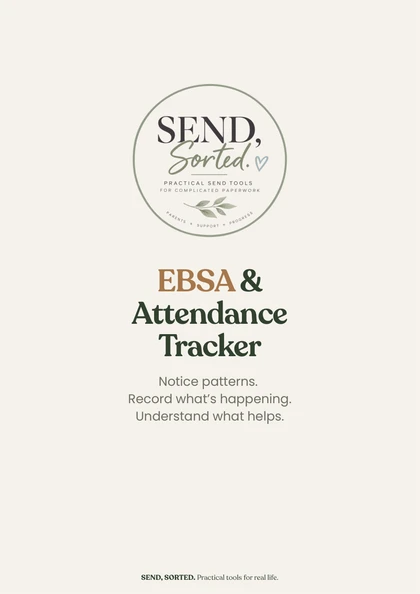
FREE PRINTABLE
FREE EBSA & Attendance Tracker
Noticing changes in your child's attitude towards school? Start recording attendance, worries, possible triggers and patterns with our free printable tracker.
Download Your Free TrackerNo signup. No payment. Just a practical resource to help you get started.
Frequently asked questions
Is EBSA a medical diagnosis?
No. Emotionally Based School Avoidance describes difficulties attending school associated with emotional distress. A child may also have a health condition or SEN that needs assessment, but the EBSA description does not establish a diagnosis.
Can my child get support without a diagnosis?
Yes. You can ask school to investigate barriers, offer pastoral support and consider SEN Support without waiting for a formal diagnosis. Explain what your child finds difficult and how it affects learning, attendance and everyday life.
Can school anxiety cause tummy aches or headaches?
Anxiety can involve physical symptoms, but there are other possible causes. Do not assume symptoms are anxiety or that your child is making them up. Discuss persistent, severe or concerning symptoms with an appropriate health professional.
Should I force my child into school?
The NHS advises understanding what is making a child anxious rather than forcing them into a stressful situation without discussing it first. Prioritise safety and talk to school about a supported approach. Attendance duties still apply; record and report difficulties, seek health advice where needed and work on an agreed support plan.
Does saying my child has EBSA automatically authorise absence?
No. EBSA is not a blanket exemption from attendance requirements. Report the reasons for absence, ask school how it will be recorded and discuss support and any evidence needed. Seek individual advice about formal attendance action.
Do I need a doctor’s letter for every absence?
DfE guidance says schools should not routinely ask for medical evidence for every illness absence. Evidence may be appropriate in particular circumstances, including where clarification of health needs is needed. Ask what evidence is being requested and why, and share relevant advice where available.
Can a reduced timetable continue indefinitely?
A temporary part-time timetable should only be used in very exceptional circumstances, be agreed with parents and have clear review and end points. Ask how education will be supported and what the plan is towards full-time provision. Seek advice if it continues without a suitable plan.
Does my child need an EHCP for Section 19 education?
No. The Section 19 duty concerns suitable education for children of compulsory school age where the legal conditions apply, whether or not they have an EHCP. Section 61 EOTAS is a different legal arrangement; it is not an automatic next step for every child with attendance difficulties.
What if school says my child is fine in class?
Share specific observations from home and ask school to look at transitions, breaktimes and the effort involved in getting through the day. Good grades or a quiet presentation do not rule out difficulties. Agree how both school and home will monitor whether support is helping.
Is the EBSA & Attendance Tracker really free?
Yes. The existing SEND Sorted PDF can be downloaded without registration, an email address or payment. It is a recording tool, not a diagnostic assessment or a substitute for professional advice.
Sources
Sources checked: 12 October 2026
- NHS: Anxiety in children
- NHS: Where to get urgent help for mental health
- GOV.UK: Working together to improve school attendance
- GOV.UK: Mental health issues affecting a pupil’s attendance
- GOV.UK: Education for children with health needs who cannot attend school
- GOV.UK: Special educational needs support
- IPSEA: School anxiety
- IPSEA: Asking for an EHC needs assessment
- Education Act 1996: Section 19
- Children and Families Act 2014: Section 61
You do not have to solve it all at once
Start with one small step: write down what you see, ask for a conversation, or speak to your GP. Your child’s distress is real, and asking for help is part of looking after them.
Keep reading: